Home · Getting there · From Oaxaca City
Oaxaca City to Puerto Escondido: every option in 2026
A new highway cut this journey from eight hours to three, and a remarkable number of guides still haven't noticed. If you read advice written more than about eighteen months ago you were told to brace for seven to ten hours of hairpin turns, motion sickness and grim endurance. That advice is obsolete. Here's what changed, what it costs now, and which option is actually right for you.
What changed: the Barranca Larga–Ventanilla highway
President López Obrador inaugurated the Barranca Larga–Ventanilla highway on 4 February 2024, closing out a project first initiated under President Zedillo in 1999 — twenty-five years of stops, starts, land disputes and construction blockades across five federal administrations.
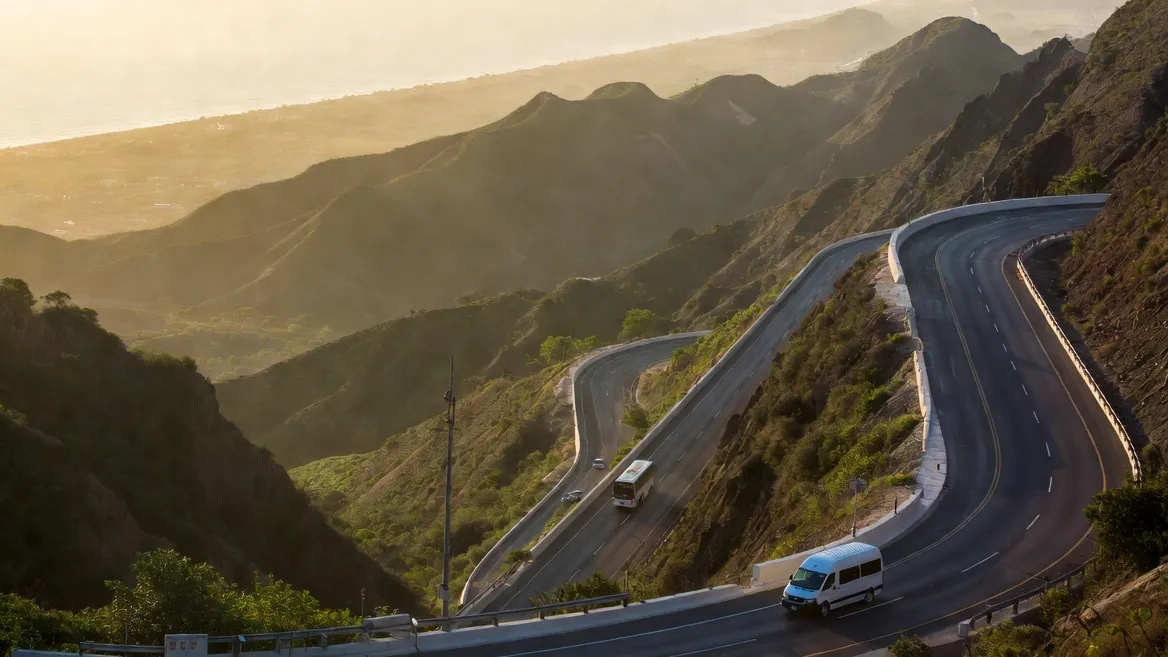
The engineering is not modest. Across 104 kilometres, the road carries two lanes with shoulders, two toll plazas, fifteen junctions, ten bridges, three viaducts, three tunnels and over a hundred crossing structures, with design speeds between ninety and a hundred and ten kilometres per hour. It replaced the worst sections of the old Highway 131 entirely. Normal driving time from Oaxaca City dropped from six to eight hours down to about two and a half to three in good conditions.
One note on what to call it. Several travel sites refer to this road as "Highway 135D." That designation shows up in secondary sources but not in the official project documentation, which describes it simply as the Autopista Barranca Larga–Ventanilla. When you're talking to a driver or a ticket agent, ask for la autopista or la carretera de cuota and you'll be understood instantly. Ask for a highway number and you may get a blank look.
The tolls, precisely
This is the detail almost nobody publishes correctly, and it's worth knowing before you're at the booth counting notes. There are two toll plazas in each direction. Each charges 234 pesos for a standard car or small SUV, which means 468 pesos one way and 936 pesos for a round trip. Cash is accepted at every booth and most now take credit and debit cards, but bring small bills — it moves the queue along, and the queue is the only slow part of the drive.
There is a wrinkle worth knowing if you live in Oaxaca. At inauguration, state residents were exempted from tolls, with the stated intention that only visitors and freight transport would pay. That arrangement was tied to the previous federal administration's term, and whether it still applies in 2026 is genuinely unclear from published sources. If you're a resident, ask locally rather than assuming either way.
Your five options, compared honestly
ADO or OCC bus — the default right answer
ADO and OCC now run the new highway, departing from the ADO terminal in Oaxaca de Juárez and arriving at the Puerto Escondido terminal in three to three and a half hours. Tickets run roughly three hundred to five hundred pesos depending on class and departure time.
Here is the catch that will ruin your day if you miss it. Not every departure uses the autopista. Some ADO and OCC services still run the old mountain road, the ticket is slightly cheaper, and it is not always clearly labelled on the booking site. When you buy, ask explicitly whether the service goes por la autopista or por la libre — sometimes called la serrana. That single question is the difference between a three-hour trip and a seven-hour one, and it is the most useful sentence in this guide.
Book at least a day ahead during Semana Santa, July, and the December–January peak. Outside those windows, same-day tickets are usually available.
Our verdict: For most people this is the right choice. It's the most comfortable option at roughly the same price as a van, with luggage stored properly in the hold rather than strapped to a roof. Just confirm the route before you pay.
Shared shuttle — best for door-to-door
Around five to seven hundred pesos per person, three and a half to four hours, using the new highway, carrying eight to twelve passengers. The service picks you up at your accommodation in Oaxaca City and drops you near your hotel in Puerto Escondido — usually Zicatela or the Adoquín. Most Oaxaca guesthouses and hostels can arrange one with a day's notice.
It's marginally slower than the bus because of the pickup circuit, but you skip both terminals entirely. If you're heading for La Punta or anywhere the bus terminal isn't convenient to, the door-to-door saving is real and worth the premium. See where to stay for which neighbourhood you're aiming at.
Colectivo or shared van — cheapest, with an ethical option
Shared vans run roughly three hundred to three hundred and fifty pesos, and most now use the new highway rather than the old mountain route.
Worth knowing about: Ruta Coatlanes Costa is a van service operated by the Coatlanes indigenous communities affected by the highway's construction. It's one of the few ways to route your transport money directly to the communities that carried the cost of the road you're travelling on.
One practical caveat. There's a decent chance your luggage rides on the roof. Loads are tied down properly and things rarely go missing, but keep documents, electronics and anything irreplaceable in a bag on your lap.
Fly — forty minutes, if the maths works
Aerotucán and Aerovega fly Oaxaca City to PXM in roughly forty minutes on small aircraft, and the route over the Sierra Madre del Sur is spectacular in clear weather.
Whether it's worth it is a straightforward calculation. You pay a substantial multiple of the bus fare to save about two hours door to door once you've accounted for getting to and from both airports and arriving early enough to check in. The honest answer is that since the highway opened, flying stopped making sense for most travellers. It remains genuinely useful in three cases: you're very short on time, you get badly carsick, or the highway is affected by weather or a blockade. Fares and airlines are on our flights page.
Drive it yourself
The most enjoyable version, and the highway is a real pleasure to drive — sweeping curves, long views over the Sierra Madre, and green valleys dropping away below you. Budget 468 pesos in tolls each way plus fuel.
Three pieces of genuine advice. Drive it in daylight the first time. Keep cash for the plazas. And understand that road blockades — bloqueos — are a normal feature of Oaxacan civic life: occasional, usually announced locally in advance, and worth checking before a long drive rather than discovering at kilometre sixty.
Once you're in Puerto Escondido, a car is more liability than asset in La Punta and Zicatela, where parking is scarce and everything is walkable. Consider whether you need it for the whole trip or just the journey.
The old roads, and why you might still want one
The mountain routes still exist, and one of them still has a purpose.
Highway 131, through Sola de Vega and San Gabriel Mixtepec, was the historic direct route — around 245 kilometres, seven to eight hours, with dozens of switchbacks on the descent. It's free, and now essentially pointless as a through route unless the autopista is closed.
Highway 175, via San José del Pacífico, is a completely different road, and travel guides conflate the two constantly. It runs about six and a half hours through the Sierra Madre del Sur to Pochutla, near Puerto Ángel — which then requires another sixty to ninety minutes westward along the coast to reach Puerto Escondido. As a way of getting to Puerto Escondido, it makes no sense at all.
As a way of getting to San José del Pacífico, it's the only option. That cloud-forest village sits at 2,400 metres and a lot of people build a deliberate overnight around it. The new highway doesn't pass anywhere near it — San José is roughly two to two and a half hours from Oaxaca City on the old road, and it's a genuinely lovely place to break a journey.
Our verdict: Take the autopista. Take the old road only if San José del Pacífico is the point, and if you do, stay the night there rather than attempting the whole thing in one push.
When this trip gets ugly
The highway removed the difficulty but not the seasonality.
During Semana Santa — Holy Week fell between 29 March and 5 April in 2026 — the usual two and a half to three hours stretches to four to six hours or more on the Thursday and Friday before Easter. Toll plazas and highway entry points see their longest queues in the afternoon and early evening, which is exactly when everyone decides to leave.
The same compression hits the December–January peak and July. If you're travelling in any of those windows, leave early in the morning, book transport in advance, and don't schedule anything tight for your arrival day. Our month-by-month guide covers which weeks to avoid entirely.
One thing worth understanding about this road
The highway is not universally celebrated locally, and it's worth knowing why before you drive it.
Construction ran through repeated conflict with the communities it crossed, including a blockade by the municipality of San Vicente Coatlán in 2022 over grievances that remained unresolved after years of promised dialogue. Reporting at the time raised a question that hasn't been settled since: whether a fragile, largely undeveloped coast was prepared for the volume of visitors a three-hour drive from the state capital would inevitably bring.
That question is being answered in real time, and everyone reading this is part of the answer. Spending money with local operators, staying in locally owned places, and travelling outside the peak crush are small choices that compound. Our dining guides flag which places are locally owned, for what it's worth.
Arriving in Puerto Escondido
Buses arrive at the terminals near El Centro, which is walkable from there. Zicatela is a short taxi or colectivo ride, La Punta is furthest at twenty to twenty-five minutes, and Rinconada sits quietly over on the airport side of town — the full breakdown is in where to stay.
Colectivos run the coast road constantly and are the cheap way to move between neighbourhoods once you're settled. See our getting around guide.
Oaxaca to Puerto Escondido: FAQ
How long does Oaxaca to Puerto Escondido take in 2026?
About two and a half to three hours by car on the new highway, three to three and a half by ADO or OCC bus, and forty minutes flying with Aerotucán. Anything quoting seven to ten hours is describing the old mountain road.
How much are the tolls?
Two plazas in each direction at 234 pesos each — 468 pesos one way, 936 round trip for a standard car. Cash everywhere, cards at most booths.
What's the cheapest way to get to Puerto Escondido from Oaxaca?
Shared vans at roughly three hundred to three hundred and fifty pesos. ADO buses start only slightly higher and are considerably more comfortable, which makes the bus better value for most people.
Do all buses use the new highway?
No. Some ADO and OCC departures still run the old mountain road and it isn't always labelled. Ask specifically whether the service goes por la autopista.
Is it still worth flying from Oaxaca City?
Rarely. The forty-minute flight saves about two hours door to door at a significant premium. Worth it if you're very short on time or prone to motion sickness.
Can I still go via San José del Pacífico?
Yes, but not on the new highway, which doesn't pass nearby. You'd take Highway 175 — around two to two and a half hours from Oaxaca City to San José — then continue to Pochutla and west along the coast. Best done as an overnight stop.
How bad is Holy Week traffic on this route?
Bad. The usual three hours becomes four to six or more on the Thursday and Friday before Easter, with the worst toll queues in the afternoon and evening.