Home · Things to do · Bioluminescence
Bioluminescence in Puerto Escondido: when to actually go
Swimming in glowing water is the single most oversold experience on this coast, and also one of the most genuinely extraordinary. Both are true, and which one you get comes down almost entirely to timing. Some people describe floating in liquid starlight. Others describe an hour in a dark boat wondering what they paid for. Same lagoon, same operators, different nights. This guide is mostly about how to be in the first group.
What's actually glowing
The light comes from Pyrodinium bahamense, a marine dinoflagellate that emits cold blue-green light when physically disturbed. Disturb the water and it flashes. That's the whole mechanism — which is why the effect responds to your movement rather than glowing steadily like a lamp.
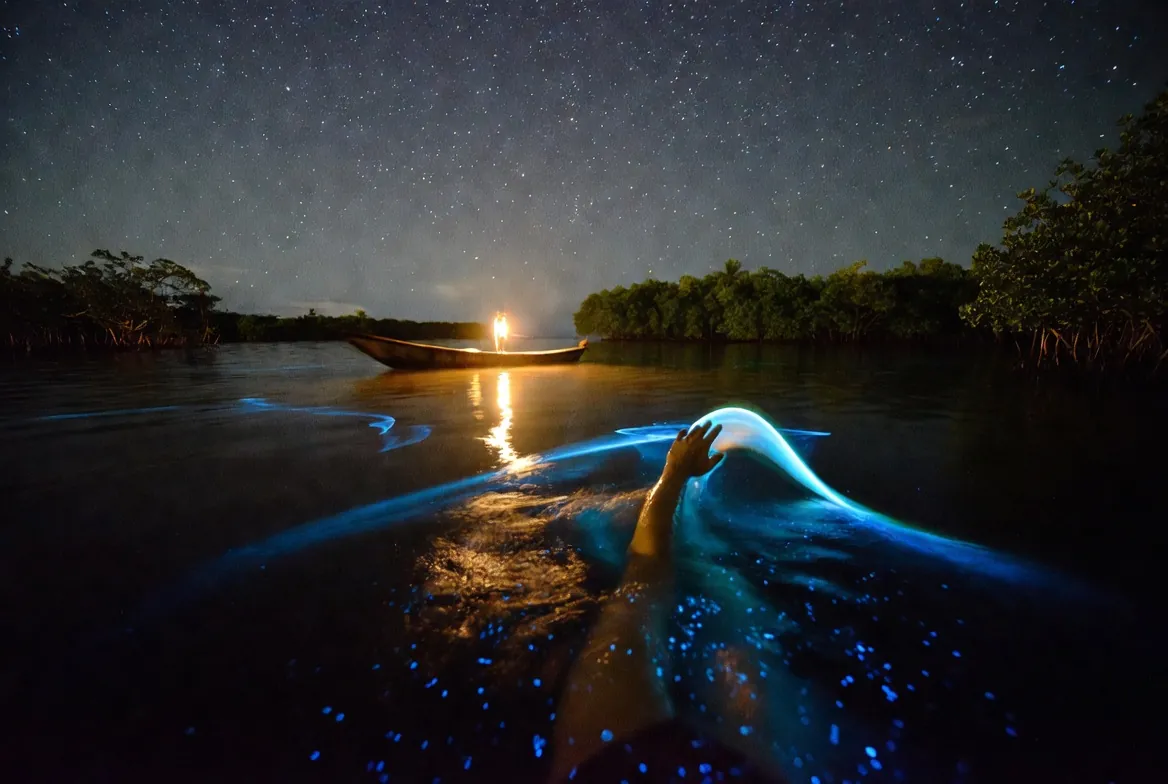
Dip a hand in and your fingers trail blue fire. A fish passing below leaves a glowing outline. A paddle stroke leaves a luminous wake that fades over three or four seconds.
Manage your expectations about the photos. Almost every image you've seen advertising these tours is long-exposure photography, heavy processing, or outright stock imagery from somewhere else. Operators themselves acknowledge that the promotional pictures are illustrative and that capturing real bioluminescence requires professional low-light cameras with long exposures. The real effect is quiet and surreal and genuinely nothing like the processed photos. Your phone will not capture it. Accept that on the boat and you'll enjoy it more.
The two lagoons — and why the choice matters
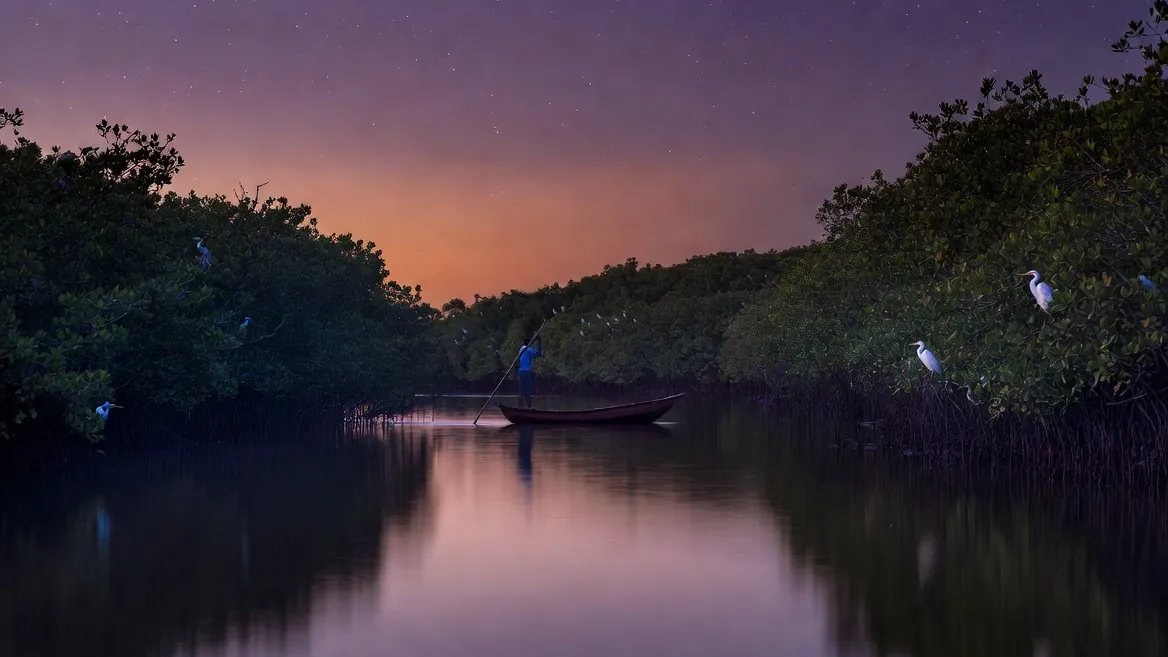
Laguna de Manialtepec sits a short drive west of town, a nine-kilometre estuary system just outside Puerto Escondido. It's the easy option: pickup from your hotel, roughly a three-hour round trip, back before midnight.
Lagunas de Chacahua sits inside a national park roughly two hours west. Chacahua has a stronger, more consistent plankton population and is bioluminescent essentially year-round — but reaching it is an all-day commitment, typically an eight-hour excursion that combines the lagoons, the beach and the village.
Our verdict: If bioluminescence is a nice-to-have on a short trip, do Manialtepec on a good night. If it's the reason you came, or if you're travelling during Manialtepec's weaker months, do Chacahua and treat the glow as the finale of a full day rather than the whole outing.
Season: the part the tour sellers muddle
Sources disagree on Manialtepec's season, and the disagreement is not innocent — vendors selling year-round tours have an obvious reason to describe a wide window. Here's what the independent accounts converge on:
- The season runs roughly May through December, when the plankton are most active.
- Several long-term local sources narrow the strongest window to July through December.
- Others describe May through October as the reliable band, tied to the mix of fresh and salt water and warm conditions.
- Chacahua, by contrast, produces bioluminescence year-round.
The common thread is that Manialtepec is strongest in the warm second half of the year, and that January–April is its weakest stretch. If you see a source claiming Manialtepec peaks in the northern winter, treat the rest of that page with suspicion.
Moon phase is the single biggest variable
This matters more than season, more than operator, more than price.
The best nights of any month are around the new moon, when the sky is at its darkest and the glow reads brightest. During full-moon nights, observation is effectively not possible. The trap is that moonlight overpowers the plankton — and when it does, operators take you into a small blacked-out hut or tent on the water so you can see anything at all. That's a workaround, not the experience you booked. Guest accounts describe exactly this: going on a half-moon night, being taken to a floating blackout tent, and still enjoying it — but it isn't the open-water version. If you read a bad review of Manialtepec, the overwhelming likelihood is that the reviewer went on a bright-moon night.
How to plan around it: look up the new moon date for your travel month and book within roughly three or four nights either side. If your trip only overlaps a full moon, either book Chacahua instead or skip it and spend the money on something else. Our month-by-month guide can help you position the trip.
Two other conditions stack in your favour: warm water above about 25°C, and no heavy recent rainfall — fresh water dilutes the salinity and temporarily thins the organism concentration. The ideal night is a new moon, in the warm season, after a few dry days.
What a tour actually involves
A typical Manialtepec trip runs about three hours, with pickup around 8:00pm and hotel drop-off by 10:30pm. Time actually in the water is roughly 30–40 minutes, and staying in the boat is an option if you'd rather. Life jackets are provided and a guide stays in the water with you — no swimming experience is required. Some operators include a Oaxacan snack such as pescadillas.
Bring: a towel, a dry bag, mosquito repellent, and something warm for the boat ride back. Leave your phone in the dry bag.
The thing nobody selling a tour will tell you
There are crocodiles in Manialtepec. American crocodiles (Crocodylus acutus) live in the lagoon and are commonly seen on daytime kayaking tours. Guest accounts confirm guides keeping watch with a torch from the boat while swimmers are in the water, and note that guides tend to describe them as "not alligators" rather than addressing the question directly.
We're not telling you not to swim — thousands of people do it every season without incident, the animals concentrate in the mangroves rather than the open middle of the lagoon, and operators do watch. We're telling you because you deserve to make that decision knowingly rather than discover it from a stranger's review afterwards. If that's a dealbreaker, stay in the boat. The glow off a paddle stroke and the wake is still remarkable, and no one will mind.
Our verdict: Go, on a new moon, between roughly July and December, and go expecting a quiet natural phenomenon rather than a neon light show. Booked that way it's one of the best nights you'll have here. Booked on a full moon in March it's a wasted evening and a bad review waiting to happen.
Do it from here
 5 h
5 hSunset in the manialtepec lagoon with bioluminescence
Check availability →
 4 h
4 hPuerto Escondido: Manialtepec Lagoon by Kayak
Check availability →
We may earn a commission when you book through these links, at no extra cost to you. Prices and availability shown on Viator are current at booking.
Making a fuller day of it
Manialtepec is worth visiting twice, or once properly. The estuary supports over 200 bird species — roseate spoonbills at dawn, mangrove channels by mid-morning — and the best birdwatching runs December through March in the early morning, which is conveniently the opposite of the bioluminescence season. Kayak and paddleboard rentals operate on the lagoon during the day.
Nearby: Playa Bacocho for turtle releases, and the quieter western beaches on the way out of town.
Bioluminescence: FAQ
When is the best time to see bioluminescence in Puerto Escondido?
At Manialtepec, roughly May–December with the strongest activity July–December, and always as close to the new moon as you can manage. Chacahua's lagoons glow year-round.
Does the moon really matter that much?
Yes — it's the biggest single factor. Around the full moon the ambient light washes out the glow and operators resort to a blacked-out tent to make it visible. Book within a few nights of a new moon.
Which lagoon is better, Manialtepec or Chacahua?
Manialtepec is closer and easier — a three-hour evening trip. Chacahua has stronger, year-round plankton but requires an all-day excursion of around eight hours. Choose based on how much the glow matters to you.
Can you swim in the bioluminescence?
Yes, at both lagoons, with life jackets and a guide in the water. Staying in the boat is always an option.
Are there crocodiles in Manialtepec lagoon?
Yes. American crocodiles live in the lagoon and are regularly seen on daytime tours. They concentrate in the mangroves rather than open water, and guides keep watch during night swims — but you should know before you book.
Can I photograph the bioluminescence with my phone?
Realistically, no. The promotional images you've seen are long exposures or stock photography. Capturing it needs a proper low-light camera and a tripod.
How long is a bioluminescence tour?
Manialtepec runs about three hours door to door, typically 8:00pm pickup and 10:30pm return, with 30–40 minutes in the water. Chacahua trips run about eight hours.